1 CORINTHIANS 13
Because the Body of Christ is so united, any impact on a single individual member will have a knock-on effect, for good or for ill, on every individual member and on the entire body. The point of everyone working at their specialist skills and giftings is to benefit the whole body and each individual member of it. So we need great wisdom and heavenly advice on how to exercise these powerful gifts that the Holy Spirit has placed within us.
Imagine what would happen if we took the radioactive core of a nuclear power station and placed it in the middle of the local supermarket or chose to launch some of it as the warhead of a long-range missile! The very material that had previous done so much good would now be doing incredible harm. The main difference between nuclear power and nuclear warfare is how you choose to deploy this high-energy material. By analogy, we need to take the same degree of care over how we deploy the power of God – our methods and motives. Therefore, Paul writes 1 Corinthians 13 to explain the motivation and the methodology of the use of these gifts and ministries. There is really only one way to do it: the way of love! The final verse (31b) of Chapter 12 is really saying: ‘This is the only way to deploy the gifts and ministries of the Spirit – and it is a most excellent way’.
The purpose of any spiritual gift is to do good to others, to love the Body of Christ and to love God himself. If you want to know a really good definition of love… sadly there isn’t one! So Paul spends verses 4 – 8 of Chapter 13 giving a series of illustrations and examples, moving towards the conclusion that love is like God and that God is love. And in the end, that is all there will be – God and his love. The gifts will have been discarded near the gates of heaven, and the faith and hope will all have been fulfilled. Their purpose will have been accomplished, because then we will see Him face to face, with no room for doubt and no place to hide! From then on, we will have all knowledge and an intimacy with the Lord that we cannot even imagine today.
Therefore, we are called to express and administer the gifts of the Holy Spirit in a way that is purely loving towards our fellow believer and towards the unsaved person. The delivery of each gift is a ‘means to an end’ – a package that always contains love as its contents. Love is the motivation, the reason, and the goal of all that we do. God is love.
SONG OF SONGS 1 – 8
What is Song of Songs really about? Why is it in the Bible? Its title (in 1:1) is “Solomon’s Song of Songs” (or “Greatest of Songs”) and indeed Solomon is mentioned seven times in the song too. 1 Kings 4:32 says that Solomon wrote 1,005 songs – and this may therefore have been the best of the lot. The date of authorship is unknown but would have been around the 10th Century BC if Solomon himself was in the fact the author (which I shall assume from now on). Its theme is unmistakably and unashamedly a celebration of the passionate romantic love and sexual union between a man and a woman, as a wonderful and joyful part of God’s creation. This book has always been regarded as a legitimate part of biblical wisdom literature, validating its portrayal of intense erotic love – within the proper context of betrothal and marriage – as a great gift of God, to be received and enjoyed with gratitude and celebration.
I believe that this theme is the main purpose of the inspired scripture, as originally written and delivered to the nation of Israel. It uses beautiful and descriptive language to ‘flesh out’ Genesis 2:23-25 and to widen our understanding of the Lord’s creative purpose; He is, after all, the ultimate marriage-maker! Solomon, the song-writer, has used subtle and delicate language to describe the beauty and intimacy of the love relationship and its activities, always avoiding crude titillation and yet painting a picture of wonderful closeness, tender love, and intense passion – attributes that God himself intended to be embedded within all courtships and marriages. Solomon uses analogies within the biological world, within food, drink, jewellery, and horticulture, to make his erotic comparisons; it is artistic, it is beautiful, and it works!
If that was the original meaning to its original readers (vital to understand and interpret any passage of scripture), it has been given additional meaning by Jewish and Christian teachers; it is seen as an allegory of the love between God and Israel and, later, between Christ and his Bride, the Church. Nowhere in the New Testament is there a direct quote from Song of Songs, however, which keep these theories in perspective and do not justify us making too much of them – particularly at the expense of the book’s original purpose.
It is true that in Revelation 21 and 22, there are several references to the New Jerusalem – the Church – coming down as the Bride of Christ. And in Jeremiah 2:2, the Lord says: “I remember the devotion of your youth, how as a bride you loved me and followed me through the wilderness, through a land not sown”. But to read too much of this into The Song would be ‘eisegesis’ (putting meaning into the text) rather than ‘exegesis’ (getting meaning out of it). This is, of course, a danger in all biblical interpretation, where we have a pet theological theory and use it as a kind of ‘filter’ to interpret every passage in the bible. It is dangerous and leads eventually to heresy (literally ‘an imbalance’); biblically one then ceases to learn any more from the Word of God.
You can read the whole Song for yourselves – it really does work best if you read it aloud in one sitting. If you are married or betrothed, then read it together, taking the appropriate man’s and woman’s speeches, rather like a great Shakespearian play! Next time you have a wedding anniversary, why not plan to read it together like this?
BibleProject’s summary of the book is here: https://youtu.be/4KC7xE4fgOw?si=Ofq5hq5QhPM8YnAf
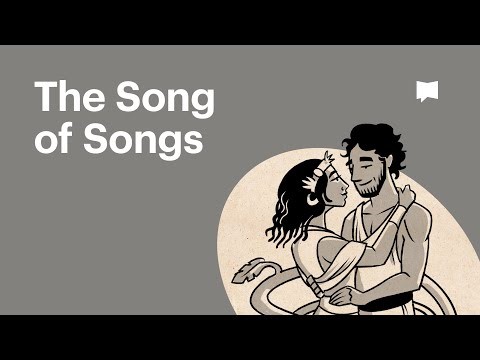
Some key verses that interest me:
1:4b. “We rejoice and delight in you; we will praise your love more than wine”. A good relationship will delight and inspire those around it, not just the couple themselves.
1:5-6 “Dark am I, yet lovely…” “…darkened by the sun…” “…they made me take care of the vineyards…”. Deeply browned skin was not considered desirable, but the verses here say that she was nevertheless very beautiful. Solomon seemed to think so, anyway!
1:13. Myrrh was used to perfume royal wedding robes (Psalm 45:8).
1:16-17. Verdant bed, cedars as house beams, and firs as rafters: the lovers were lying outside under the stars!
2:4. The banquet hall and the banner are possibly metaphors for a public expression of love; every lover wants eventually to be recognized as such, publicly.
2:10-13: Signs of Springtime imply times of love and fertility! For us, today, this metaphor of the barren winter ending, and new spiritual life awakening, is a very encouraging and comforting thought.
2:16 “My beloved is mine and I am his”. This phrase occurs three times and gradually changes to put more focus on the other person’s rights and needs (see 6:3 and 7:10). Relationships, especially healthy love relationships, will always mature to be more ‘giving’ than ‘taking’.
3:1-4. These verses show that separation is something that can increase the passion of a relationship and make you appreciate their presence when they are close by. It also warns you not to take your beloved for granted.
4:1-15 is a fabulous description of the bride’s beauty from the bridegroom’s perspective. Since beauty is truly in the eye of the beholder, we need to practise looking! Brush up your observational skills!
4:16. You can do whatever you like in your own garden!
5:10-16 These give the bride a chance to describe her lover too. She ends with: “This is my beloved, this is my friend, daughters of Jerusalem”. Lover and friend: what an amazing God-given combination. You cannot go too far wrong if you choose to marry your best friend (of the opposite sex), assuming that there is the necessary spark of passion too. (I speak from experience here!)
6:4-9 These allow Solomon to be suitably descriptive too. And he elevates her above the sixty queens and eighty concubines to call her the very best!
6:13. Interesting that she is called the ‘Shulammite’ (or ‘Shunamite’) girl. There was a very stunning, beautiful such young woman who warmed King David’s bed (literally, not metaphorically) in the last year of his life (1 Kings 1:1-4). It is just possible that Solomon had fallen in love with her. He would also have been very angry – fuelled by jealousy – when his brother, Adonijah, attempted to usurp Solomon’s kingship by attempting to marry that Shunammite girl; see the full story in 1 Kings 2:13-25.
Song of Songs chapters 7 and 8 are highly descriptive and suggestive – leaving little to the imagination. The book ends with a sense of continuation; this is a love-relationship that will last and will turn into a great marriage. Human passion does change as time goes on, but that fire of love should continue to burn more brightly and become more mature, respectful, selfless, and no less exciting. God made us that way! If you think that your own marriage relationship has rather dried out (in the hot sunshine?) or has become full of weeds, then ask God to help you water it again and remove the barriers to intimacy. Perhaps also ask wise friends or leaders for advice.
 The Big Picture